
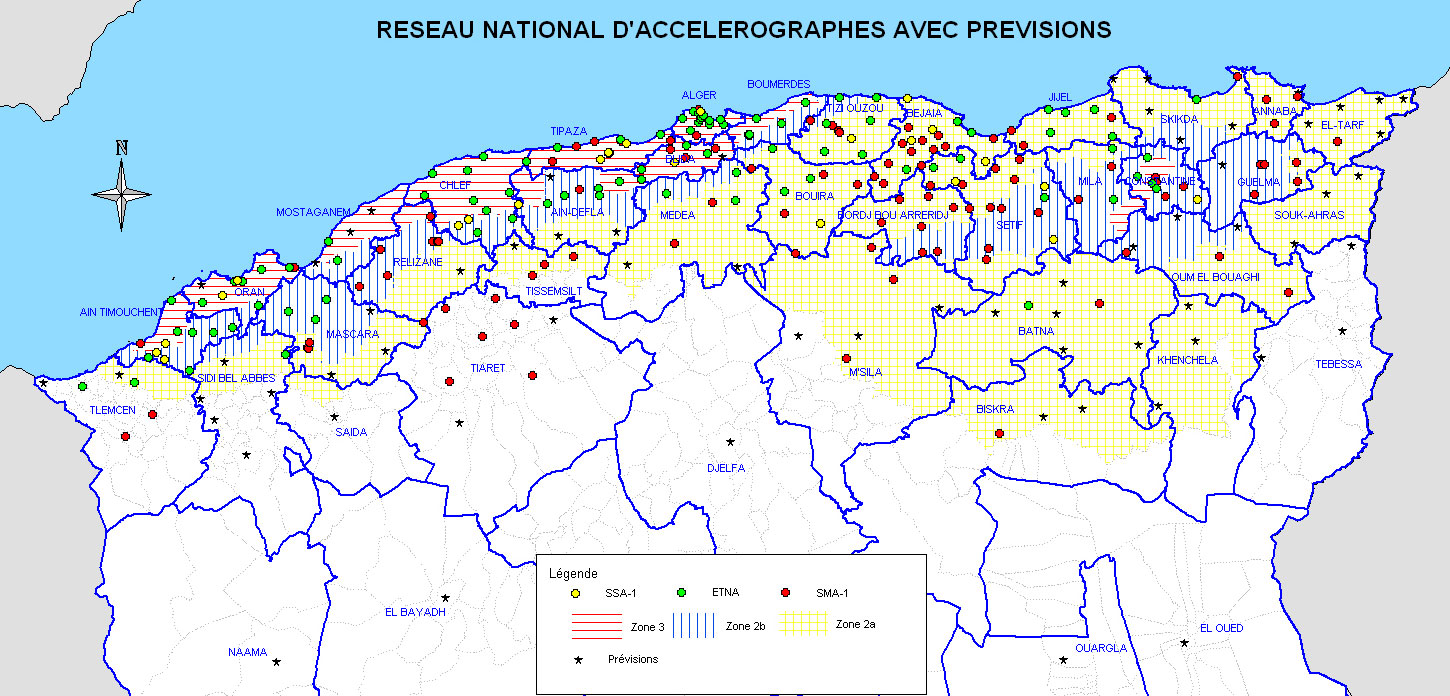
The idea of establishing a national network of accelerographs dates back to 1976, when Algeria decided to develop a national seismic planning framework. The catastrophic El-Asnam earthquake of magnitude 7.3 (October 1980) served as a catalyst for acquiring accelerographs. It is important to remember that at that time, Algeria did not have a network of accelerographs for recording strong ground motion. The few available recordings of this earthquake were captured by a Yugoslavian mobile network dispatched to the scene after the main shock and therefore concern aftershocks. Following this catastrophic earthquake, it became urgent and necessary to:
- monitor seismic activity in Algeria,
- record strong ground motions,
- understand the physical phenomenon (wave propagation, fault model),
- develop attenuation laws,
- create a seismic zoning map of Algeria,
- define and model seismic motion for structural calculations.
The recordings
This report presents a comprehensive overview of the national accelerograph network managed by the CGS and its future development prospects.
The Recordings
Recording of Algerian earthquakes from El Asnam (1980) to Laalam (March 20, 2006)
Earthquake database of:
|
Reference |
Date / Time(GMT) |
Magnitude |
Région |
Download |
Request |
| 1 | 22/08/2015 /……. |
3,8 |
AIN DEFLA |
Download | |
| 2 | 14/05/2010 12:29 | 5.3 | M’SILA | Download | |
| 3 | 18/06/2008 13:24 | 4.6 | CHLEF | Download | |
| 4 | 06/06/2008 20:02 | 5.5 | ORAN | Download | |
| 5 | 02/06/2008 17:37 | 4.5 | MILA | Download. | |
| 6 | 16/12/2006 19:34 | 4.4 | CHLEF | Download | |
| 7 | 22/07/2006 13:22 | 3.7 | ALGER | Télécharger | |
| 8 | 20/03/2006 19:44 | 5.0 | LAALAM | Download | |
| 9 | 21/05/2003 18 44 | 6.8 | BOUMERDES | Download | |
| 10 | 10/11/2000 20:10 | 5.8 | BENIOURTILANE | Download | |
| 11 | 22/12/1999 17:36 | 5.7 | AIN_TEMOUCHENT | Télécharger | |
| 12 | 18/08/1994 01:13 | 5.9 | MASCARA | Download | |
| 13 | 29/10/1989 19:09 | 5.9 | CHENOUA | Download | |
| 14 | 27/10/1985 19:34 | 5.9 | CONSTANTINE | Télécharger |
The Recordings
Recording of Algerian earthquakes from El Asnam (1980) to Laalam (March 20, 2006)
Earthquake database of:
- Constantine (1985)
- Chenoua (1989)
- Mascara (1994)
- Ain Benian (1996)
- Ain Témouchent (1999)
- Beni Ourtilane (2000)
- Zemmouri-Boumerdes (2003)
Use of accelerograph data:
- Development of the first attenuation law for Northern Algeria
- Microzonation of Northern Algeria within the framework of the revision of the Algerian Seismic Regulations (RPA)
- Validation of seismic hazard models
- Quantification of site effects within the framework of microzonation studies
- Development of experimental response spectra and regulatory
- Location and magnitude estimation of the Ain Temouchent (1999), Beni Ouartilane (2000), and Zemmouri-Boumerdes (2003) earthquakes
The CGS short-period seismograph network (intervention network)
It was used to record aftershocks of the Zemmouri-Boumerdes (2003) and Laalam (2006) earthquakes
- It was the first to be installed in the field; the stations were operational 48 hours after the main shock
- This performance resulted from good coordination between the center's various departments and, above all, from the availability of shelters for the accelerographs distributed around the seismic zones in northern Algeria.
- Data recorded by the intervention seismological network during the 2003 campaign contributed to the study of the distribution of aftershocks to the Zemmouri-Boumerdes earthquake, in collaboration with CRAAG (Algeria) and IPGS (France).
- This study was published: The 21 May 2003 Zemmouri (Algeria) earthquake Mw 6.8: Relocation and aftershocksequence analysis (Geophys. Res. Lett.).
The recorded data are retrieved by technicians.
- They are backed up in two ways:
- Analog data recorded on photographic film are archived traditionally in a dry environment at a constant temperature.
- Analog data are digitized using SCANVIEW software with a sampling interval of 200 sps.
- Digital data (accelerogram and seismogram) are recorded on a hard drive with a copy on CD-ROM.